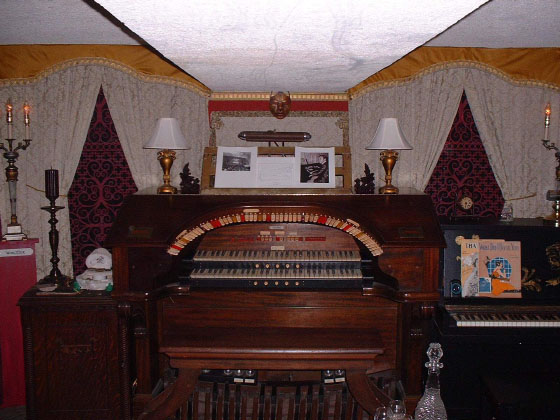
Kirby Console as it appears today.
You are visitor number 

 to this website.
About the Organ
The Kirby Organ has been reunited! Opus 1614 is one again!
Opus 1614 was built at the North Towanda Wurlitzer plant, and installed in the Kirby Theatre in Houston, TX in 1927. It was a style EX. The style E has 2 manuals and seven ranks of pipes. The "X" indicated that the organ was divided into two chambers on either side of the stage. The organ was removed from the theatre sometime in the 1950's, and the theatre was torn down in 1970. Throughout the 1970's, the organ was installed in a number of residences in Texas until finally making it to Wichita, KS. More later...
Specifications
Trumpet 61 pipes
Concert Flute 97 pipes
Salicional 73 pipes
Celeste 61 pipes
Tibia 85 pipes
Open Diapason 85 pipes
Vox Humana 61 pipes
My manual specifcations will come later.
If you have any questions, email me at
wurlitzer1614@aol.com.
THE THEATRE PIPE ORGAN FOR THE LAY PERSON
What a person normally sees when he or she sees a theatre organ is not actually the organ. It is the organ's console. This is the control center for the organ. This organ has two manuals or keyboards. It also has stop tabs. On these are engraved the different sounds that the organ can create. These activate different sets of pipes and can be put in groups to create stop combinations. The white buttons under the keys are called pistons. They activate preset stop combinations that the organist can use while playing. This makes it much easier for the organist to change the sound of the organ right in the middle of the performance. The other thing that a person might possibly see are shutters. These have yet to be installed on this organ. These can be opened and shut by the organist using expression pedals. These are larger pedals that are located directly above the pedalboard. The shutters control the volume.
Behind the shutters is where almost everything else is, but it all starts with the blower. The blower basically puts air into motion and creates pressure. This pressure is brought to the organ through a large pipe called a windline. The windline is attached to a large box called a windtruck. This is what the regulators sit on. A regulator is a large bellows that is held closed with springs. As the pressure builds, the regulator opens up and this closes valves that stops the air from entering thus regulating the pressure that enters the organ. This is necessary due to the fact that the pipes need a certain pressure in order for them to speak properly. From the regulator the air is piped to the different windchests in the organ. Inside the windchests there are two valves and one magnet per pipe. These magnets are activated when a key is pressed at the console. The magnet activates small pneumatics. Pneumatics are pockets or bellows. There are two of these for each pipe too. The pneumatics open and close the valves which allow air to escape through the pipes.
The percussion parts of the organ work in much the same way, except instead of the air escaping through a pipe it escapes into another pnuematic, which inflates and either pushes a stick toward a drum or bar to strike it, or the pnuematic shakes something, such as a tamborine.
All of this comes together to make the sound that is characteristic to the theatre organ.
Check out the American Theatre Organ Society's website.
Go to: www.atos.org
We would like to thank all of the people that have helped contribute to the realization of this organ.